The truth about petrolatum
Petrolatum cuts a wide swath in skin care. Why are many companies choosing not to use it?
By Diane Peters
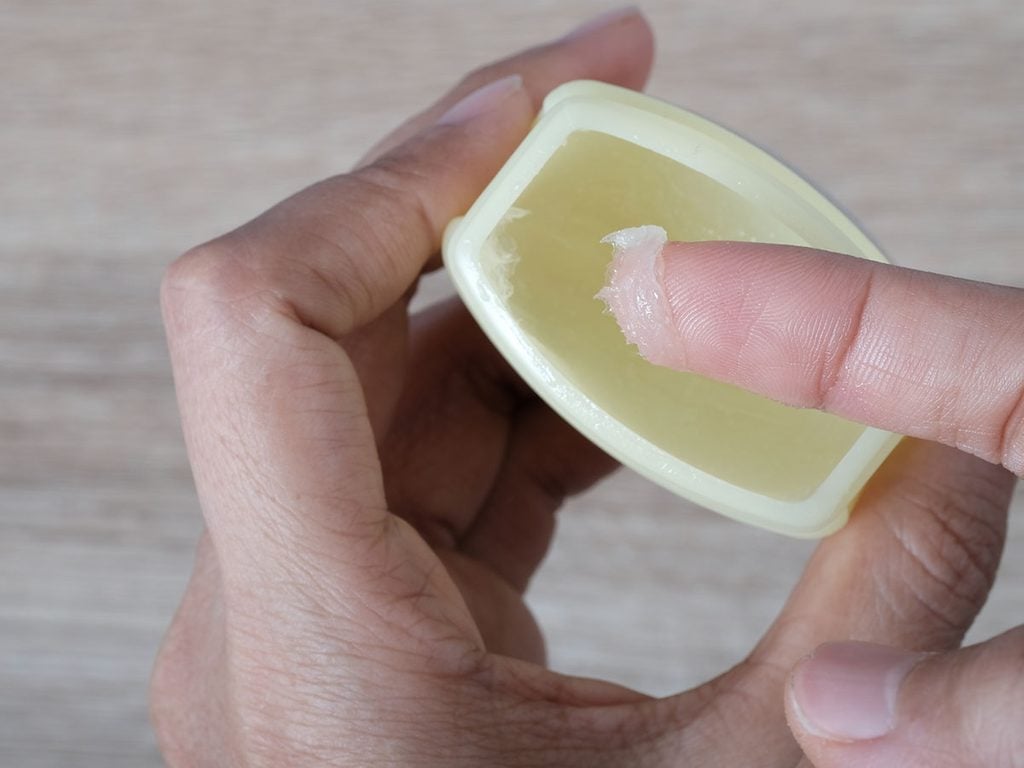
When my two toddlers had itchy rashes on their chests, my doctor diagnosed eczema. The cure: no more bubble baths, and plenty of thick, perfume-free moisturizer. “The best thing you can use is good old Vaseline,” she said.
Doctors like mine have been recommending petroleum jelly (also called petrolatum) for more than 100 years. In the 1850s, chemist Robert Chesebrough started the process of distilling and cleaning the thick gel found on oil wells. By 1870, Vaseline was being sold in the United States.
In industry, petrolatum acts as a lubricant for machinery. Today, we also use it to relieve diaper rash, heal raw noses and soothe chapped lips. (Some people also use it as a sexual lubricant, but it weakens latex condoms.) It’s also an ingredient in a variety of moisturizing products. The Environmental Working Group (EWG), a U.S. non-profit organization that does environmental and safety studies, says there’s petrolatum in one out of every 14 cosmetic products on the market, including 15 percent of lipsticks and 40 percent of baby lotions and oils. Plus, it’s used as an active ingredient for healing cuts and burns.
So why are a host of new cosmetic products—many of them organic or natural—promoting themselves as “petrolatum free”?
Is it safe?
Health Canada considers petrolatum non-toxic. As for the Canadian Cosmetic, Toiletry and Fragrance Association (CCTFA), a trade organization that consults with the government on ingredients, its stand is that “it’s pretty much as universally safe as any substance could possibly be,” says spokesperson Mike Patton. However, the EWG gives it a “moderate hazard” safety rating, and says cosmetics that use petrolatum need more study for safety.
Why? The EWG says—and governments and the CCTFA acknowledge—there is a risk of contamination from polycyclic aromatic hydrocarbons (PAHs), cancer-causing chemicals found in crude oil and its by-products. While no studies have ever shown a direct link between petrolatum and cancer, the European Union put numerous grades of petrolatum on a list of dangerous substances. Only highly refined petrolatum can be used in cosmetics there.
Petrolatum used in cosmetic and personal care products sold in Canada is also a highly refined grade and must meet all of the standards set by the United States Pharmacopeia (USP), including limits for PAHs. Petrolatum used as an active ingredient in over-the-counter drugs goes through even stricter regulatory control.
Is there a chance toxins could be missed during processing and testing? Companies that produce petrolatum products say no. “Our personal care products are tested and meet all of the safety and regulatory requirements as set by Health Canada,” says Paul Hughes, technical manager for Unilever Canada, maker of Vaseline. “Some people are creating fear among consumers by telling only part of the story.”
Does it heal skin?
While some beauty companies are promoting petrolatum alternatives, other manufacturers swear by its ability to moisturize and heal. Petrolatum seals off the skin from water and air, and “it allows the skin to heal itself,” says Calgary pharmacist Skip Gibson. He’s vice-president of sales and marketing for George’s Special Dry Skin Cream, a petroleum jelly–based cream that he helped create.
“Petroleum jelly is the most effective moisturizer available,” says Vancouver dermatologist Dr. Richard Thomas. “The reduction in water loss makes it easier for the epidermis to continue normal function.”
But there’s a potential downside. A study that was published in Pediatrics in 2000 found that extremely-low-birth-weight infants treated with petroleum jelly were more likely to develop systemic candidiasis; it created a warm, moist place for fungi to grow. “Sometimes you want the skin to breathe more,” says Celeste Lutrario,vice-president of research and development for Burt’s Bees, which does not use petrolatum in its products. She says petrolatum is an occlusive barrier, locking in moisture—but it does not allow moisture to be absorbed from the atmosphere. For example, lip balms with petrolatum and other petrochemicals can be less moisturizing than those with emollients that enable moisture exchange, contends Lutrario.
Is there an environmental impact?
Petrolatum comes from crude oil, and as such is not a renewable resource. Of course, the volume of the ingredients in one jar of petroleum jelly or a bottle of body moisturizer doesn’t come close to that used to fuel cars or run factories. Still, Health Canada is currently investigating the environmental impact of petrolatum in cosmetics.
Concern for our planet and its resources is another reason why some companies are using oils from coconuts, sunflowers and olives in the formulation of their products. But these oils have an environmental footprint, too: They come from farmland, potentially displacing food crops.
Alternatives to petrolatum in cosmetics are more expensive and trickier to formulate. Right now, petrolatum is cheap, plentiful and generally safe, and it mixes up easily in the lab to create the products we use every day—it’s not going anywhere soon.
This article was originally titled "The truth about petrolatum," in the October 2009 issue of Best Health. Subscribe today to get the full Best Health experience—and never miss an issue!—and make sure to check out what's new in the latest issue of Best Health.
Best Health Magazine, October 2009


Petrolatum may be safe but it is from a non-renewable source. I personally prefer glycerin, vegetable source, non-smelling, less greasy, thinner and easier to absorb into the skin. Perfect for chapped hands, to keep skin supple. Many european cosmetics manufacturer prefer to use it. I seem to be sensitive or even allergic to mineral oil (petrolatum product) so no petrolatum for me.
I purchased some new makeup that had and started to see white little bumps rising up underneath my skin. I found out the makeup had petrolatum in it. My skin couldn't breath and the pimples would form. I stopped using the makeup and the pimples left.
If people want to use a petrolatum free moisturizing product, Alba un-petroleum is great. It looks like vaseline but it works better. It is also great for eczema.
good grief, come on folks its just vaseline and it does work. Environmental footprint? Doesnt everything we use come from the earth ???
Seriously, I think that more and more we are treated like guinea pigs. Vaseline is toxic??? Are you serious, where is this information from? All these new discoveries. The flu shot causes people to be more likely to get the H1N1 and now this. How and who are we supposed to listen to. Causing a panic attack in people isn't the brightest idea. Are these facts 100%? Who's to say that after getting the H1N1 flu shot , we won't be prone to cancer somewhere down the line?! Do we keep listening or practice common knowledge?
Asbestos was okay to use for insulation, building materials, and old movie screens. Companies knowingly sold products that were hazardous to consumers. Just google asbestos to read the story of deception corporations used to continue to sell a product they knew was harmful. It's happened before it will happen again.
I am so getting tired of hearing about how things that have been around for over 100 years can now all of a sudden cause cancer. You know what? BREATHING causes cancer. LIVING causes cancer. Caner is everywhere, and mankind can not avoid it. You think that because of this I am going to stop using Vaseline? Get over it.
I've used petroleum jelly every day for fourteen years, due to a skin condition that I have, and I have spoken with some of the best dermitologists in Canada regarding the safety of it and they have always maintained that it is just fine, even considering how much I use it. I have never had any side-effects or harm come to me as a result of using it.
I would also like to point out that in recent decades, it was also said by "authorities" (some even sponsored by the government) that eggs and butter were harmful. Just because some "authority" shows skepticism regarding a certain product, doesn't mean we need to boycott it. Think these things through before you jump on the bandwagon!
I don't understand the comments if the nay-sayers. The tobacco industry paraded for decades an endless line of "experts" to testify to the safety of their products. There are obvious commercial reasons to state this product is asfe. But is it?.
I feel an unbiased research program on this product IS necessary. It's too widely used Not to know.
I am a 57 year old grandmother. My late grandmother skin looked and felt like that of an alligator's. Unfortunately I inherited the same skin type. I startes using petrolatum vaseline 10 years ago and stopped using cosmetic at the same time. I cannot tell you how many times I am asked what I use on my skin. No blemished, scars nor wrinkles. If and when I do get a scar/blemish the vaseline clrears it up within months. Even the cosmeticians don't beleive me when I tell them I don't wear make up. I SWEAR BY PETROLATUM VASELINE. Won't leave home without it.
I have to agree, pls think of what works best for you. I am an eczema sufferer, I'm going with what I know works instead of Hydrocortisone or Protopic. These are also chemicals that could/can potentially harm the body in different ways. At least Petroleum jelly is an alternative when the exzema is bad and you need a break from using what the drug companies want you to use.... Just a thought.
I have suffered with eczema for years I was born with it and it runs in my family. Petrolatum jelly is the only thing that works. I have tried many different things but always go back to it. So Whatever...find something else to complain about!
Really?? 100 years and no death, don't we have enough to worry about today then to start worrying about this. One day it is this and tomorrow it is something else. These research companies make people paranoid soon everyone will just hide in their house, work from home and never socialize with the outside world in fear of catching something or being killed by Petrolatum Jelly aka Vasaline. I say Really??
companies are forever thinking up new ways to get us to spend our money on their products. one way is to creat fear that a common household item is "newly toxic" so we have to buy the more expensive fake toxic free stuff.
vasoline is harmless to humans and even to cats whose body mass is much less. got hairballs? try a pea sized ball of vasoline. the cat doesn't die, and yes it has lots of fight in him too! hmmmm..... i guess it's true, nobody in the last 100 years or so hasn't died either...
Don't zebras have hooves??
There are natural moisturizers that are safe to use. I personally use organic coconut oil. Just because something was used for 100 years doesn't mean it's safe. Doctors prescribed heroin and cocaine for colds and toothaches for over 100 years. I guess it's safe to take those drugs then. Most products have petro chemicals in them. To avoid them look for products labelled 100% organic, they can only be found in health food stores. If a product contains sodium lauryl sulphate or sodium laureth sulphate they are petro chemicals. They are even in deodorant but so is aluminum. Do your research before buying products, go organic, I did and I haven't been sick in over 3 years!
Well if petrolatum is bad for your skin...you should read some of the food/candy labels that have "mineral oil" which is a derivative of petrolatum. How can this be possibly good in food? How can they even allow it? Obviously the goverment doesn't care.
Sunflowers, olives and coconuts are displacing land for food??? Excuse me, but I do believe they are all edibles!!!!!!
While I agree that petrolatum may not be the most "natural" product on the market, it does wonders for incontinent people (babies and adults alike) to prevent skin breakdown from having urine against their skin. However, vaseline should NEVER be used as a sexual lubricant! It is not water soluble, and therefore will not breakdown or be absorbed. It will sit in a woman's vagina, and be a breeding ground for infection. Always use a water soluble lubicant like KY. Thus ends my after-school special!
Hi BHM,
Re 'petrolatum', I see this whole issue as a general breakdown in our teaching of basic logic. Petrolatum 101 teaches us that a) petrolatum is an oil, chemically, and b) we use in our normal metabolic lives a number of essential oil like vitamins such as Vitamins A & E, c) everything we 'injest' via either stomach or skin passes through our GI tract and is either used or eliminated. Conclusion: if you cover you skin in an undigestable mineral oil in which essential oils are immersed and eliminated you will suffer deficiencies. Or "are you nuts" putting petrolatum any where near your body.
Regards, G Reid
Petrolatum cannot be safe these manufacturers are afraid to go belly up so sure they are going to stick to their products. The smell and gas that emits from us using petrol for our car is consider toxin and even linked to cancer. Products that go on our bodies should be safe enough to consume if it will kill if eaten then why should it be applied on our skin. Petrolatum is a drying agent asks the many people who are seeking moisturizer for their hairs, they try and avoid petrolatum so how can it be considered moisturizer?
Great for certain things!!
The sky is falling.....the sky is falling!! Here we go again. Please, give it a rest! After 100 years on the market and no problems? Gee, let's study it to death and see if we can't find something..................anything..............
Here we go again, instead of allowing people to use common sense, let's provide hysteria and inaccuracies to stop using something that has been helpful for many years and replace it with what......more chemicals, gosh these are really good for you. It has been proven that many old remedies are far more helpful with simple problem conditions, but these provide nothing to company's bottom lines. Please people, use your brain, that's why you were given one and were taught to think for yourself. Don't look for zebras when you hear hoofbeats!