What You Need to Know About Taking Care of Your Aging Parents
 Updated: Aug. 10, 2017




Caring for aging parents can be difficult, especially when you’ve got kids at home.
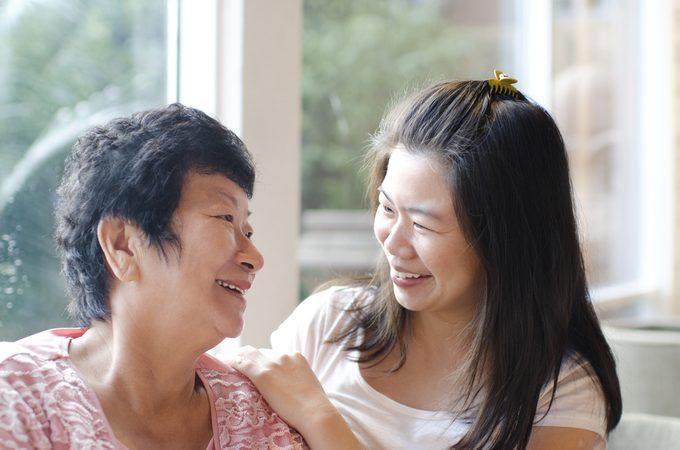
Taking care of elderly parents
When my father died in 2004, my mother was bereft. I found myself driving weekly to my hometown near Owen Sound, Ont.—a six-hour round trip—to comfort her and take care of grocery shopping and gardening, tasks she no longer cared to do. She and my dad had enjoyed an active social life, but now she tended to sit alone and wait for my visits.
I promised my mother I would visit every day if she would move closer to my home in Toronto. She finally agreed, so I found a facility that offered “aging in place.” It’s a concept many residences adopt to make retirement living more seamless for seniors who may be mobile and independent when they arrive, but will later need assisted-living services for illnesses such as dementia, and after-care for strokes and heart attacks.
When my mother arrived at The Briton House Retirement Centre, she had arthritis, which affected her mobility, and some dementia, but she could still play a skilled game of bridge. I hoped the card games, shopping trips and theatre outings offered by the residence would lift her depression. They did, but she still counted on the promise I had made.
The daily visit was more than a chat and a game of Wild Rummy. It included washing crusted dishes, picking up discarded clothing, watering droopy plants and making Mom’s bed, all while I was working full-time. This was a significant departure from the mother I had known, who prepared elaborate dinner parties well into her late 80s, planted extensive flower and vegetable gardens and thought nothing of taking a bus to Toronto to shop for the day.
However, she had suffered internal injuries from a fall in late 2003 and by the time I moved her closer to me in early 2005, her health had deteriorated dramatically. In the last year of her life, I dressed her, lifted her from her bed to her walker and enveloped her in the daily requested hug. On a weekly basis, there were medical appointments, bills to pay, and laundry and shopping to do.
My mother never complained about being lonely, but if I missed a day she was desolate. For three years until her death in late spring 2008, her care profoundly affected the decisions I made about my own life. Working late, dinner invitations and vacations automatically raised the question, What about Mom?
An aging population—and the men and women who take care of them
The number of people in Canada age 65 and older has now surpassed four million—that’s one in eight of us. Incredibly, in a 2007 Ipsos-Reid survey, one in three Canadians age 45 to 60 reported being caregivers to aging family members. Forty-four percent of those surveyed supported children as well as an elderly relative.
Middle-aged women (45 to 64 years old) devote almost twice as much time as men do to unpaid caregiving. Within that age group, working women spend 26.4 hours a month caring for an aging parent, compared to 14.5 hours for employed men, according to Statistics Canada.
How do we women do it? With difficulty, and often at our own expense. Few employers offer flexible hours or paid time off for caregiving. A 2006 Health Council of Canada survey indicated that 22 percent of people who had been caregivers in the preceding year had missed one or more months of work and 41 percent had used personal savings to provide care.
For me, juggling the demands of a job with the demands of caring for my mother was stressful, and filled with conflicting emotions. A doctor’s appointment for my mother could take an entire morning away from my workday, and although my employer was understanding, I felt guilty. And caring for my mother took away from the time I could spend with my grown children, and I often felt resentful of that—after all, my mother had never had to care for either of her parents when she was my age; she and Dad had been free to travel the world.
Caring for aging parents while raising children
It’s even tougher for those truly sandwiched by caring for a parent and children at the same time, which is the situation for May Chan, a full-time professional who lives in the Vancouver area. Her elderly mother, who has diabetes and had quadruple bypass heart surgery a few years ago, lives with her, her husband and their two kids, age 10 and eight. “My mom went straight from living with her parents to living with her husband,” Chan explains, “so emotionally she is dependent. It’s taken her five years, since my dad died, to develop a network of friends.”
For Chan, the downside is juggling her job, the kids’ activities and her mother’s needs. Some mornings, she drives her children to school and her mom to the pool, or to line dancing or tai chi—and that’s before she heads off to her office. After work she drives the kids to extracurricular activities and plans the evening meal. “Everyone has different needs. I am caring for the very young and the very old, so I’m caught in the middle,” she says. Added to that are emotional stresses. “Because parents never perceive you as grown up, my mother often treats me like I’m still young,” says Chan.
Yet she says there’s an upside: The whole family goes on vacation together, and Chan’s kids have a warm relationship with their grandmother. “My children are learning to respect seniors, to be less selfish,” says Chan. “My son has already asked me which of them I will live with when I’m old.”
The rewards of caregiving for aging parents
Caregiving, I learned, is like parenting, but with a big difference: Ultimately, caring for an infant usually has happy outcomes, while caring for an aging parent does not. Still, I have no regrets. My mother and I had experienced our share of friction over the years; I had been her difficult, rebellious teenager, and she was relentless and unbending in her strict rules for me. But we had both mellowed and were able to share laughter, memories and, best of all, mutual appreciation.
I had her bag packed for a trip to the cottage when she died suddenly in May 2008. When I unpacked it later, I saw she had put in score sheets so we could play Wild Rummy. That was one of several moments that undid me. Her sudden death was in some ways a relief; she had not suffered a long illness, a prospect I was dreading both for her and for me. Yet I miss the smile that lit her face every time I appeared, and her caustic wit. And even though I had become her caregiver, she was still, at 91, my mom—solicitous if I was feeling ill or had had a tough day at work. So I feel a sense of peace that I honoured her dedication to me with the best I could give in helping to care for her.