Preserved Meyer Lemons







A staple of Moroccan, Algerian, and Tunisian cuisine, preserved lemons are sweetly sour and salty and add a wallop of flavor to any dish that calls for a strong lemon flavor, including condiments like homemade mayonnaise and vinaigrette.
Web exclusive: October 2009
Excerpted from Well-Preserved by Eugenia Bone Copyright © 2009 by Eugenia Bone. Photographs copyright © 2009 by Andrew Brucker. Excerpted by permission of Clarkson Potter, a division of Random House of Canada Limited. All rights reserved. No part of this excerpt may be reproduced or reprinted without permission in writing from the publisher.
| Servings |
| 2500ml jars |
| Servings |
| 2500ml jars |
- 10 Meyer lemons regular lemons, or a combination (see Note below), scrubbed
- 1/2 cup kosher salt
|
Ingredients
Servings: 500ml jars
Units:
|
- With a sharp knife, remove the stem ends of 6 of the lemons. Slice the lemons into quarters from pole to pole.
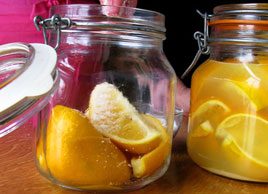
- Bring 2 wide-mouth pint (500 ml) jars and their bands to a boil in a large pot of water fitted with a rack. Boil for 10 minutes. Remove the jars with tongs (the tongs don't need to be sterilized). Simmer new lids in a small pan of hot water to soften the rubberized flange. When the jars are dry but still hot, shove the lemon wedges into the jars, trying not to crush the fruit too much, but do pack them in, sprinkling 3 tablespoons (45 ml) of salt per jar as you go and making sure the salt is well distributed throughout. Meyer lemons are softer than regular lemons and therefore easier to squash down into the jar.
- Juice the remaining 4 lemons. Top each jar with 1 final tablespoon (15 ml) of salt, then distribute the juice between the jars, making sure the lemon wedges are completely covered with juice. If you see air bubbles along the side of the jar, slip a butter knife down into it and press aside the fruit to allow juice to fill the space. You may need more lemon juice depending on the juiciness of your lemons.
- Set on the lids, and screw on the bands fingertip tight. Let the lemons ferment on your kitchen counter for 2 weeks for Meyer lemons, 3 to 4 weeks for regular lemons, which have tougher skins, and ferment until they are soft enough to tear. Turn the jars upside down every other day to make sure the salt stays well distributed. The lemons will become soft and the salt and juice mixture syrupy. Transfer the fermented jars to the refrigerator, where they will hold for up to 6 months.
- To use, remove a lemon wedge and scrape off the seeds. If you see white stuff on the lemons, don't worry: it's just a precipitate of salt, oils, and whatever from the pith. I find with Meyer lemons I don't have to remove the pith before using (the flesh mostly disintegrates into syrup). Scrape the pith off regular lemons before using. For a milder taste, or if you are using quantities of preserved lemons in a dish, rinse them before cooking.
If you use regular lemons, you will need to have a few more on hand for juicing. If the lemons feel hard, soak them in room-temperature water for 15 minutes before using. To get the most juice from them, boil lemons for 2 minutes, cool, and then juice.