Why you should eat more seaweed
Seaweed is an extremely nutritious vegetable that's often overlooked as a meal option. Find out how to sneak it into your diet more often
By Signe Langford
Yes, that’s what we said: eat more seaweed. For many—probably most North Americans—sea vegetables or seaweed just isn’t on the menu. Perhaps the only time many of us eat the healthy stuff is when we have sushi, where it’s in miso soup, wrapped around maki and tossed with a sweet vinaigrette in bright green wakame salad. But, take a look around the world, and for millions of folks—especially coastal peoples—sea vegetables are and always have been a major part of the diet.
The nutrition in seaweed
As dark, leafy veggies go, seaweed is about as nutrient-dense as it gets. Eat about a gram of seaweed and your daily iodine needs are taken care of. Iodine is one of those micronutrients that’s hard to come by in foods, and that’s why it’s added to ‘iodized’ table salt: to help bolster the population’s thyroid and brain health. But more and more folks are eschewing good old table salt for all those designer salts, and that’s just more reason to reach for some seaweed.
Seaweed packs super-high amounts of calcium—higher than broccoli—and in terms of protein, it’s almost as rich as legumes. There’s also a good amount of vitamins B-12 and A and it’s a great source of fibre. But not just any old fibre. Seaweed is mostly soluble fibre, the kind that turns into a gel, slowing down the digestive process, thus inhibiting the absorption of sugars and cholesterol.
Now you might be thinking, “This all sounds great, but I haven’t got the foggiest idea what to do with it!” Fair enough. Unless you were raised in Japan or in a small, coastal, fishing village here in Canada, how would you?
Well, we’ve got 10 ways to use seaweed and get it into your daily diet—incognito if necessary!
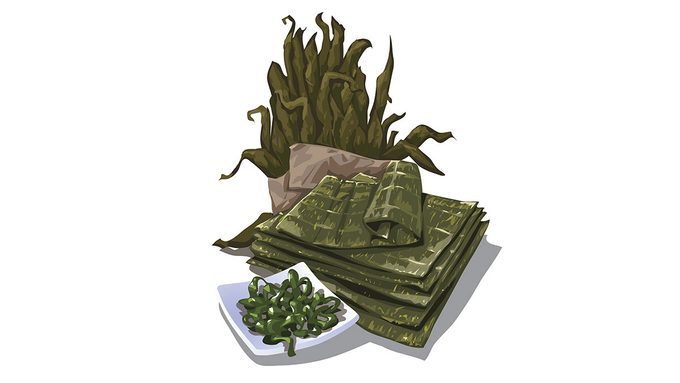
First, go shopping. Explore the Asian markets and familiarize yourself with the different types of sea veggies on the shelves. Next, buy a selection of seaweed, bring them home and start tasting. They should taste briny, almost fishy and each will be a bit different in taste and texture, from chewy to papery. Some will be dried and require re-hydration and some will be fresh and found in the fridge or freezer. No Asian markets near you? No worries! Most grocery stores and health food shops carry nori—for homemade sushi—at the very least.
How to cook and eat seaweed
1. Slip a sheet of nori into a wrap before you roll. Cut nori to size and layer inside sandwiches and burgers.
2. Tear or cut nori into salads, soups or stir-fries. If your family objects, make the pieces tiny—they’ll never even notice!
3. Make maki rolls and little individual hand rolls with any filling you like, inside a nori cone.
4. Drain and mash a can of salmon with cooled, cooked brown rice, mayonnaise, green onion and celery, and roll up inside a sheet of nori.
5. Cheat a little and treat the whole family to delicious—though admittedly not as nutritious—seaweed chips. This salty, crispy, delicious snack can be found in Asian markets.
6. Finely chop or snip dried seaweed into mashed potatoes, pasta dishes, stews and casseroles.
7. Pulverize dried seaweed in a food processor and sprinkle over almost anything! Spirulina is in fact seaweed and it’s delicious in a smoothie. Try keeping the seaweed powder on the dining table, just as you would the salt and pepper. If it’s right there, folks are more likely to eat it!
8. Stop by the local sushi joint and pick up some wakame salad to serve with dinner or better yet, learn to make your own.
9. Fresh, leafy seaweed can be chopped and quietly added to kale or collards.
10. And of course, because of seaweed’s natural, slight fishiness, it’s perfect in fish chowders, fish casseroles and seafood pastas.
Don't miss out! Sign up for our free weekly newsletters and get nutritious recipes, healthy weight-loss tips, easy ways to stay in shape and all the health news you need, delivered straight to your inbox.
Web exclusive, January 2012


I love seaweed. I eat it plain. Dried seaweed smells a lot like fish food, but once you acquire a taste for it (which doesn't take too long) you'll find yourself craving it. The kind I get is dehydrated, organic, and dried into sheets, so I'll usually tear it up into little bits and munch on it a bit when I want to make my taste buds happy.
I haven't actually tried raw seaweed though, like the wet kind, so I couldn't tell you if it's any good....
much love,
~A
how could you recomend seaweed when all the towns and citys along the east coast and west dump there sewage raw into the bays and rivers and still say the waters are clean. Think again you can see the sewage floating to the surface in the harbours, where do you think these large cruise ships clean their tanks at after all those passengers releave them selves.
Dulse AKA Seaweed is very plentiful along the shores of Nova Scotia and an ocean away from the Pacific! Here, it is a very popular treat and is used in many dishes, but for some, simply heating it on an old wood stove is the best treat of all!:)
I also grew up close to the sea in Ireland. We harvest seaweed from the crystal clear waters of Achill Island where we have a holiday home and use it in our daily recipes. I mostly use it finely ground or flaked as it can be added to absolutely everything. I use freshly shredded sea lettuce in savoury cheese scones and nori flakes and spirulina in cranberry and cobnut choc covered flapjacks. Candied dulse in homemade Baileys icecream is divine! There is an excellent company you can order your ready flaked seaweed products and they do a great sea spice which is a mix of seven sea herbs lovely in gravy and soups. Quality Sea Veg www.seaveg.co.uk email:qualityseaveg@eircom.net
enjoy x
Seaweed is very nutritious, however since the nuclear fallout in Japan, any seaweed from the Pacific Ocean has the added bonus of radation! I love sushi and asian seaweed snacks, but I'm passing up on them for the next couple of years until the level of radioactivity in the area diminishes. Unfortunately, most seaweed available in North America comes from the waters around Japan and unfortunately much of the nuclear fallout ended up in the ocean around Japan. So beware and for now get your nutrients elsewhere! If anyone knows where to get seawood from other areas of the world, please do post, I'd love to know!
Good article. I've lived by the ocean all my life and grew up eating dulse- that eggplant colored seaweed sold in health food and grocery stores. It has more flavour than nori and is an unprocessed local natural product. Iodine is fine is small quantities and I enjoy eating dulse every day. It is good to see that seaweed is finally getting the attention that it deserves.
As for the previous comment re:fish, I buy 'off the dock' local products and have never had a problem with quality. The folks here who work in the plants certainly consume as much fish as anyone. The lobster industry is well regulated also.
I live by the sea & can tell you from people that work on the sea & in seafood factories that I wouldn't eat most seafood of any kind anymore. If you knew what's in that seaweed/fish etc, you wouldn't either in most cases. The seas are dying, ask yourself why.
There is one reason and one reason only for me not eating seaweed and that is because of its high iodine content the taste is only suitable to those who were raised on the stuff. To me seaweed like cilantro supposedly the worlds most consumed food is unpalpable.